Showing posts with label Fordham. Show all posts

Thursday, December 22, 2011

Guest Contributor Ray Floriani -- At the Holiday Festival

by Ray Floriani

New York City - The format of the MSG Holiday Festival went through another alteration. Up until a few years ago it was contested just after Christmas. Since then it has been before December 25th and this season was not a true tournament. No semifinal and final doubleheader -- just a twin bill -- this past Saturday at Madison Square Garden.


The Holiday Festival logo

The scores:

Rutgers67 58Stony Brook
St. John's56 50Fordham

Possession and efficiency:

Off.
Poss.Eff.
Stony Brook6688
Rutgers63106


View of MSG


Off.
Poss.Eff.
Fordham6873
St. John's6883

Notes & Points of Emphasis
1. Rutgers was tested.
The American East representatives, Stony Brook worked hard on the offensive glass showing a 46-32% edge in offensive rebounding percentage. Rutgers coach Mike Rice pointed out , partially in jest, that his Scarlet Knights (6-5) had too much holiday spirit and were willing to give up second chances to the Seawolves. Stony Brook did not have an easy time finishing those opportunities showing only a 13-9 lead in second chance points. Stony Brook (3-6) basically lived on the perimeter and shot better from three (7 of 24 for 29%) than from two (9 of 36 and 25%). Rutgers shot 56% from two en route to a 54% eFG mark. Both teams had identical and sloppy 24% TO rates. Myles Mack of Rutgers led all scorers with 22 points. The freshman guard did not start but proved the old axiom 'it is more important who finishes rather than starts the game'. Mack used 18% of the Scarlet Knight possessions and obviously was very much involved.


Rutgers coach Mike Rice feels his team was in a holiday mode
giving too many offensive rebounding 'gifts'


2. Fordham is improved
They entered MSG at 4-5. Tom Pecora is getting double figure scoring from three players, none are seniors. Junior Chris Gaston leads at 14.6 PPG while the backcourt of sophomore Branden Frazier (10.0) and freshman Devon McMillan (11.6) has been effective.

Against St. John's there were opportunities. Gaston got inside but struggled to finish. He scored 11 points, grabbed 14 rebounds (5 offensive) but was 4 of 16 from the field. Both clubs failed to hit 40% eFG with Fordham at 36% and St. John's not much better with 38%. The young Ram backcourt did a nice job caring for the ball with a 15% TO rate, compared to St. John's' 22%. Red Storm got the big and arguable game decisive advantage on the offensive glass. They showed a 42-24% dominance in offensive rebounding percentage. God's Gift Achiuwa (5) and Moe Harkness (3) accounted for half of the 16 St. John's offensive boards. Harkness, a 6-8 freshman swing man, had a nice 13 point, 16 rebound double-double.

3. St. John's has concerns
The Red Storm is now 5-5. Beyond the .500 won-lost record are other issues. The exit of Nurideen Lindsey further depletes an already thin squad. In the first half against Fordham the starters went the entire way. For the game, four players put in the full forty minutes. The only one who did not was freshman guard Sir Dominic Pointer who put in 36 minutes and spelled by Malik Stith for only 4 minutes. The biggest concerns in this situation are foul trouble -- the Storm do zone frequently to stay out of that situation -- and injuries. They can ill afford an injury to anyone. With Big East play and its physical nature, practices, plus Winter and the illnesses it can bring coming up, St. John's will be embarking on conference play in a very tenuous circumstance.


The Stony Brook band entertained
and enjoyed their MSG appearance

Monday, August 8, 2011

Dove Entrails & Tea Leaves -- Pythagoreas, Minutes and Points in the A-10

The Problem with Crystal Balls
As an expression (for the sake of clarety...), the process of determining how a team will do in the next season looks something like this...


How Team A will do this season = How Team A did last season - Team A players lost + Team A players gained + Team A intangibles


The Pythagorean Winning Percentage provides one of the best measures of how a team did in previous seasons. We can use a deductive approach to analyzing how the departed players will affect the next squad by looking at who is coming back, and what they bring. Incorporating new players into the mix is about the toughest part of the process...next to accurately assessing the impact of the intangibles of course. Taking a look at the first two elements (how Team A did and who Team A will bring back) is the start of the process, and once I have those two elements,it is easier to see how the last two could affect their performance and standing next season. Comparing each teams overall Pythagorean Winning Percentage (PWP) against the average of the conference (about 54.5, the Atlantic 10 is a very good conference), then doing the same for returning minutes (based on rosters through early August) and plotting the differences to a grid provides a clear indication of where each team sits compared to the rest of the conference. I have been partial to returning minutes because I think it provides a good sense of the relative maturity of different squads, but returning points has value, and so I decided to plot a second grid with points in place of minutes, as those who check out the second chart below. Can points tell us something that minutes might not? Compare Xavier's position in the tables below...


The X-axis returning percentage of minutes (above) and returning percentage of points (below). PWP is the Y-axis. For the PWP/Returning Minutes chart above, the axis intersect at (54.5,66.4), while for the PWP/Returning Points chart below, the intersection is (54.5,66.7).

.


A quick look and the two seem to virtually identical. A closer look uncovers a few differences worth exploring.

No Surprises Here
Temple and (sometimes) Xavier plot to the (upper left) above average quadrant for returning points and for the Musketeers, just below the average line for minutes returned (> average PWP, < average returning minutes), but the Muskies jump above the X-axis (average of returning scoring) in the second table -- a quick visual on the "value of Tu Holloway". For the past three seasons these two programs have turned the A-10 regular season into a duet. Those concerned about the X-men's minutes (ie experience) next season can relax, the program has learned to level the year-to-year ebb and flow of talent through the judicious application of red shirts and transfer eligibility rules. Coach Mack has Brad Releford, a rising junior sniper, Justin Martin, a red shirt (partial qualifier) freshman and Travis Taylor (transfer from Monmouth University) in reserve from last season, ready to step into the rotation for 2012. And even as I write, Isaiah Philmore, a transfer from Towson, will practice this season and be ready to step in 2013. Excellent programs can do that.

Coach Dunphy has not established that cushion for his Owl program, but every season a rotations/role player seems to step up and have a great year. Juan Fernandez and Ryan Brooks blossomed in 2010, while Scootie Randall and Khalif Wyatt did the same in 2011.

Testing Common Wisdom
Mature/experienced teams improve over their prior performances. That saw will be tested in 2012 as 2011 bottom-dwellers Fordham and Charlotte return squads that lost a combined 25 games in conference competition last season. Charlotte's fall from grace in 2011 (the 49ers returned higher-than-average minutes from a squad that posted a greater-than-average PWP from 2010) can be attributed to the education of rookie coach Alan Major. The transition from assistant to head coach, especially when a change of program is part of the transiton, can be bumpy -- Dayton fans take note. Coach Major brings in a large class rookie this season, which may be counter productive when installing new offensive/defensive systems. Coach Tom Pecora's Fordham squad showed improvement in his first season at Rose Hill, but the squad needs an infusion of A-10 level talent to establish momentum. Will he find them among the six new faces (freshmen) coming in for 2012?

For Saint Louis, Saint Joseph's, George Washington and St. Bonaventure however, the old saw may work out in 2012. Coach Mark Schmidt put the Bonnies on an upward trajectry when he took over in 2008. A-10 Player of the Year candidate Andrew Nicholson is a major reason, but Coach Schmidt has surrounded him with solid talent. Coach Mike Lonergan's hire last April places George Washington in a position similar to Charlotte's in 2011; a new coach taking charge of an experienced squad. Having seven years at the helm of Vermont gives Coach Lonergan an advantage the Major did not have however. Early season games against Syracuse, Georgia, UAB and Kansas State should give fans a good idea of where the program stands going into conference play. Coach Phil Martelli brought in a consensus conference-best class in 2011. Better yet, the class appears to be headed back to Hawk Hill for 2012 along with most of the eligible returnees, which ought to break Saint Joseph's two year run of 20 game losing seasons. Coach Rick Majerus' four year tenure at Saint Louis has been marked with a revolving door roster and a badly timed setback in 2011. 2012 should mark a substantial turnaround for the Billikens as they return nearly all of their (young) 2011 roster and suspended clutch guard Kwamain Mitchell. Should Coach Majerus' health hold up, the Billikens should have a hand in the conference race in 2012 and beyond.

When anticipating who would plot to the (lower left) "below average" on both factors quadrant, I thought the two last place teams, Charlotte and Fordham would be the strongest candidates. Both, it turns out, return more than average for minutes and points next season. The teams that did plot to the lower left quadrant are La Salle and Massachusetts, the teams that finished #9 and #10 respectively in 2011 conference play. The Explorers had a good balance of senior leadership and young talent, but was plagued with inconsistent play throughout the season. Some changes to the roster (especially when the freshman backcourt rotation -- Tyreek Duren, Sam Mills and Cole Stefan stay for another season) may benefit La Salle's prospects in 2012 (not to mention Dr. Giannini's job security).

For UMass however, the problem is inherent to the Dribble Drive Motion offensive system implemented by Coach Derek Kellogg. The DDM relies on a dynamic lead guard to either score via penetration or (when the situation calls for it...) get the ball to someone who can. The system needs reliable secondary scorers who can catch and and penetrate or shoot from the outside (when needed) and athletic front court players who can rebound and put back should the shooter's attempt miss. If the squad (especially that lead guard) not recognize and exploit/convert the scoring opportunities, the principal ball handler becomes a volume scorer. Since Gary Forbes' senior season (2008 -- Travis Ford's last as Coach in Amherst), Kellogg's lead guards (Ricky Harris and Anthony Gurley) typically take 30% or more of the possessions and shots, but the offense does not convert those possessions efficiently enough to win consistently. The problem in 2011 is that the scoring alternatives, Jesse Morgan and Freddie Riley had lower offensive (points per possession) ratings than Gurley. Those two and Chaz Williams, a 5-9 Hofstra transfer, will be next up as lead guard/scorer in the system.

Programs versus Teams
2012 should provide an opportunity to see which Coach Chris Mooney has built at Richmond during his tenure. The Spiders graduated a substantial percentage of their scoring and minutes over the past two seasons, but have a deep roster from which to draw. If the rotation players step forward (as Justing Harper did in 2011), the team should not take a large step back from their performance over the past two seasons. Can the same be said for Duquesne and Rhode Island, two other programs that played to the conference tournament quarter finals in 2011? The Runnin' Rams' Coach Jim Baron has had to scramble the past few off seasons to fill out his roster. Though he had early commitments, all too often they did not make it to campus, and the Rhode Island mentor had to rummage through JUCO lists and AAU rosters going late into July. This past season the needs were identified, those expected to return -- Akeem Richmond excepted -- will and the signees are all coming in as well. Those stitched together rosters produced three consecutive post season runs, but Coach Baron has never had so small a returning nucleus to start the season. Though transfers Billy Baron (the coach's son) and Andre Malone won't be available until after the fall semester, early season games at Texas and with regional rivals Boston College and Providence might provide a hing about Rhode Island's fortunes in 2012. Duquesne's Coach Ron Everhart has adjusted his gameplan to exploit the advantages a smaller, more mobile squad can provide. The frantic pace (#13 in D1 per Ken Pomeroy) caught unsuspecting teams off guard which, enabled the Dukes to earn a bye bid to the Atlantic 10 Conference Tournament and a post season spot in the CBI field in 2011. Coach Everhart will have a couple of taller players to replace Damian Saunders and Bill Clark, but will they be as efficient?

Caveat Emptor
Consider that...
1. The rosters are still taking shape. In the past week La Salle fans learned that South Carolina transfer Ramone Galloway was granted a waiver to play immediately (headline announcement on the front page of the team's web site), while (not publicly acknowledged...) rising sophomore Cole Stefan left the program and the school. Some schools (Rhode Island for example) tend to delay announcements on academic probation. And injuries can strain resources (see Xavier and Temple early in 2011) or derail a season (La Salle in 2010).
2. Fans may have their favorites for preseason Rookie of the Year, but predicting the impact of any freshman is tricky, involving both talent and opportunity...with a large helping of luck.
3. Of the last five new conference coaches, Xavier's Chris Mack (hard to believe he will enter his third year as a head coach in 2012) has had the easiest path -- credit the solid program he inherited when Sean Miller moved on to Arizona. What can the struggles of Tom Pecora, a successful veteran coach charged with rebuilding Fordham and Alan Major, an Ohio State Assistant Coach whose first bite at the head coaching apple came at Charlotte suggest to us about Archie Miller and Mike Lonergan's first season at Dayton and George Washington respectively? Miller takes over a light roster and has to find bodies just to cover the next season. Combined with his lack of head coaching experience the Flyers will most likely struggle to match 2011's 7-9 conference mark. Lonergan, an experienced hand at Vermont, steps into a deeper and stronger roster. How drastically he moves the squad to his offensive and defensive systems and how hard he pushes the current roster to get there will probably influence how enthusiastically the roster responds.

Monday, June 13, 2011

Wash, Rinse, Repeat (pt 2) -- The 2012 Atlantic-10 Home and Away Slate

Flipping 2011 Home/Away Opponents
In addition to carrying the mirror opponents (home/away series opponents) from 2011, the Atlantic-10 schedule maker reversed the venues for the single game opponents. Charlotte visited Duquesne, Rhode Island, St. Bonaventure, Saint Louis and Temple in 2011. The 49ers will host those teams as single game opponents in 2012. Does this balance their schedule over the two season period? Remember that virtually no teams return their entire rosters season-over-season. The average of returning minutes in the A-10 next season (to this point) is about 66%.

Home & Away According to Pythagoreas & Seed...
I decided to take the average of the home and away Pythagorean Winning Percentage (PWP) -- conference games only -- for each team's set of opponents. I excluded mirror opponents (covered in the previous post) for this the compilation to focus on those match-ups that would not allow a return engagement (in the 2012 regular season). I also took the average A-10 conference tournament seed for each set of opponents, to determine if each team was facing an "average" set of opponents in the home or away setting -- the conference has 14 members, the "average seed" is 7.5...

Non-Mirror Opps.
HomeAway
TeamPWPSeedPWPSeed
Charlotte0.5224.90.3587.8
Dayton0.3417.40.5316.8
Duquesne0.3199.30.6146.6
Fordham0.4386.50.5876.8
George Washington0.5267.30.5658.5
La Salle0.4366.80.4887.1
Massachusetts0.3349.30.7116.3
Rhode Island0.5557.80.5468.4
Richmond0.3709.10.7107.4
Saint Joseph's0.2368.80.6914.6
St. Bonaventure0.5386.80.5558.5
Saint. Louis0.4775.50.3797.9
Temple0.5577.90.5539.5
Xavier0.4978.00.5009.0
Avg.0.4397.50.5567.5
Std.0.0991.30.1031.2

As the table suggests, there is a sharp contrast in the PWPs among visiting teams and hosts. George Washington, Rhode Island, St. Boanventure and Temple appear to have the strongest slate of non-mirror opponents, and Temple looks as if their slate of road opponents may be marginally easier than their slate of visitors (though the Owls did catch a huge break on their mirror opponents). Looking over the PWPs for road games, it appears that Massachusetts, Richmond and Saint Joseph's have their work cut out for them. For the Minutemen and Spiders, this could be problematic, as the UMass returns 60% of their 2011 scoring (points) and Coach Chris Mooney's squad returns just over 31% of theirs.
Different Strategies for Different Circumstances
A common wisdom approach to scheduling strategy might want to schedule the stronger opponents into the home arena, thereby using the home court advantage to maximum effect, while taking the weaker opponents on the opponents' home court with the notion they could be beaten in either location. For teams whose objective is to break out of the conference's lower division (or cellar...) however a counter intuitive strategy might be the better choice. Hosting weaker opponents would maximize the chances of winning conference games, while conceding the road loss to the conference's stronger teams. Very few coaches would embrace a strategy that concedes losses even before the season even starts, but as a practical approach to accumulating wins, programs like Charlotte and Fordham have few options, at least until they rebuild their programs. How do the non-mirror match-ups compare when looking at those two different approaches?

Looking for Wins...Any Wins
Rookie Coach Archie Miller may have caught a break from the schedule maker. Dayton graduated All Conference forward Chris Wright, while also losing freshmen Juwan Staten (West Virginia) and Brandon Spearman (Indian Hills CC) to transfer. The depleted Flyers return 58.4% of their minutes and 58% of their scoring. Drawing hosting duties for Charlotte, George Washington, La Salle, Massachusetts and Rhode Island without having to return the favor. Rhode Island at this point, is in line to return less than 25% of their 2011 minutes in 2012. Miller should be able to post a winning home record among these five opponents. The seed versus PWP spread for the opponents visiting the UD Arena in 2012 is interesting, about average for seed, but a comparatively low road PWP. The spread suggests those teams did not travel well in 2011.

Richmond, like Rhode Island, will have only 40% of 2011's minutes available going into 2012, a (mirrors excluded) home slate of Dayton, Fordham, La Salle (again!), Massachusetts (ditto!) and Temple should help build some confidence (and post wins) for the Spiders of tomorrow. Their (non-mirror) road slate however, should be a bit more challenging -- Duquesne, Rhode Island, St. Bonaventure, Saint Louis and Xavier. Should Coach Mooney's squad post a winning record versus those five, Richmond will be in a good position for post season consideration.

Massachusetts slumped at the end of their 2011 conference schedule, dropping their last regular season game to winless (in conference play) Fordham and then losing their A-10 first round game to Dayton. Lining up Charlotte, Fordham, Saint Louis, St. Bonaventure and Xavier for home dates should help to establish a winning home record in conference play. True as visitors the Minutemen will be hard pressed to win more than one game from their road slate -- Dayton, Duquesne, George Washington, Richmond and Temple -- but if they hosted those five would they win more than (say...) two?

Fordham's home slate -- Charlotte, Dayton, George Washington, La Salle and Xavier -- should provide the Rams with a few more winning opportunities than their road slate -- Duquesne, Massachusetts, Richmond, Saint Joseph's and Saint Louis. Returning a nucleus of Chris Gaston, Branden Frazier and Alberto Estwick provides Coach Tom Pecora with an opportunity to up Fordham's conference win total in 2012.

Making a Statement
St. Bonaventure has bettered their conference record in each of Coach Mark Schmidt's four seasons, finishing in the upper division 2011. With Andrew Nicholson a rising senior in 2012, the future maybe now, and the Bonnies drew a fairly balanced (in a PWP sense...) slate of (non-mirror) home and away opponents. Assembling a winning record at both home and on the road against those opponents would certainly serve notice the Bonnies are back, and probably put them in the conversation for a post season bid, preferably to a tournament whose name starts with an "N".

On paper George Washington appears ready to shop for more permanent digs in the A-10's upper division. Next season's (non-mirror) home and away slate seems fairly balanced per the average PWP (and note the average seed is consistent with the PWP). The question is whether new Coach Mike Lonergan can motivate the squad to perform in the face of a challenging road slate.

Temple drew the only slate that would fit the bill for an elite team -- face better teams (Dayton, Duquesne, George Washington, Massachusetts and Xavier) at home, lesser teams (Charlotte, Rhode Island, Richmond, St. Bonaventure and Saint Louis) on the road. The seed versus PWP contrast for the road opponents suggests that lineup, like George Washington's, were stronger in front of the home crowd than on the road.

Counter Programming?
On the heels of an unexpectedly good (slump at season's end excepted) season, Duquesne would probably have been better served with a stronger slate of visiting teams than Fordham, La Salle, Massachusetts, Richmond and Saint Joseph's. While there may be a measure of home crowd entertainment value in running up the score on Fordham or Massachusetts, but wide margins may (again?) obscure weaknesses in the Duke program.

Xavier drew a surprisingly balanced slate of single game opponents for both home (Fordham, George Washington, La Salle, Massachusetts and Temple) and the road (Duquesne, Rhode Island, Richmond, Saint Joseph's and St. Bonaventure). Note the home slate has an average seed within the standard deviation, while the road slate seed is just below the range established by the standard deviation (suggesting the Musketeers' hosts are better at home than on the road).

Caveat Emptor
Consider that...
1. The rosters are still taking shape -- at this point it appears that Saint Louis will return 92.8% of their minutes from the 2011 season (plus Kwamain Michell). Last June the Billikens were projected to return 82.7% of their minutes, but only 54% were on the roster when the season started. There are a variety of reasons why players, post NBA draft deadline, do not return to school, and every Atlantic-10 team has lost experienced minutes in June and later in the off season.
2. Timing can make a difference -- Duquesne ran up an 8-0 record through the first half of their 2011 A-10 slate against teams that finished the season with a collective 50-78 (0.391) conference record. Only two of those teams (Temple and George Washington) finished on the upside of 0.500 in their conference games.
3. Coaching changes can affect team dynamics, or not -- Charlotte's Alan Major had a rough rookie season as head coach, while rookie head coach Chris Mack's Xavier squad won the Atlantic-10 regular season title in 2010. George Washington's Coach Lonergan has six years of experience directing Vermont's program (and seven directing D3 Catholic University) before taking over at George Washington; the Colonials should show improvement over their 2011 conference record (health providing...). Dayton's Archie Miller, a long-time assistant, but looking at his first season in charge of a Division 1 program, may have problems matching departed coach Brian Gregory's 7-9 record.

Friday, June 10, 2011

Wash, Rinse, Repeat -- The 2012 Atlantic-10 Conference Pairs

The Flip Side of 2011
Though at least one fan blog hinted at the pairings for the 2012 Atlantic-10 Conference regular season back on June 1, the conference did not officially release the pairings until June 6. Rather than build the conference mirror opponents and home/away games from scratch for 2012 (or roughly based on the 2011 conference results), the schedulemaker apparently decided to keep the 2011 mirror opponents and flip each team's 2011 home and away opponents for 2012 -- Saint Louis played Fordham, George Washington, Richmond, St. Bonaventure and Temple on the road in 2011, so they will host those teams at Chaifetz Arena in 2012. Was this a backhanded attempt at a balanced (over a two year period) schedule? For those interested in the complete listing, visit the Conference announcement here.

Fair and Balances?
I had noted last June when looking over the Atlantic-10 conference pairings that a balanced schedule may be only one of many objectives a conference schedulemaker may have satisfy...and a lower priority objective at that. Since the conference kept the same mirror opponents for 2012 as 2011 for each team, I decided to take the average of the conference Pythagorean Winning Percentage (PWP) for each team's mirros and compare them. Mirror games constitute 37.5% of each team's 16 game schedule. These pairings can provide a team with a big advantage (or a huge challange)...

Mirror Opponents
PWPTeam
Charlotte0.735GWU, Rich, XU
St. Louis0.726Day, Duq, XU
Dayton0.724Duq, SLU, XU
Saint Joseph's0.670Mass, Rich, TU
Fordham0.612URI, Bonas, TU
La Salle0.582GWU, Mass, TU
Duquesne0.475Day, Bonas, SLU
St. Bonaventure0.453Duq, Ford, URI
George Washington0.438Char, LSU, Rich
Xavier0.380Char, Day, SLU
Massachusetts0.353LSU, URI, SJU
Rhode Island0.308Ford, Mass, Bonas
Richmond0.305Char, GWU, SJU
Temple0.208Ford, LSU, SJU
Avg.0.498
Std. Dev..0.171

"Protecting" a rival clearly still holds for the coming season, as Xavier and Dayton will renew their in state rivalry, Temple will face both Big 5 rivals (La Salle and Saint Joseph's), while Massachusetts and Rhode Island will extend their regional (New England) rivalry with another home & away series this season. Travel appears to have played a role as well, as Charlotte, Richmond and George Washington have all managed another season with mirror games. Television match-ups, Xavier/Dayton aside, appears to be a minor consideration. Looking at the average of the PWPs, it may seem the schedule maker created a "balanced" set of mirrors conference-wide, the standard deviation (and a visual inspection of the list highest to lowest) would strongly suggest otherwise.

Notes & Observations
A blend of regional rivals may help Charlotte's travel budget, but George Washington was stronger than anticipated last season, and with new coach Mike Lonergan at the helm in place of the departed Karl Hobbs combined with the return of well regarded (but red shirted last season) Lasan Kromah, the Colonials should be an even tougher challange in 2012. The Spiders lost Kevin Anderson and Justin Harper (and Dan Geriot), but Coach Chris Mooney has a deep squad at Richmond, which suggests the 49ers will again post a losing record in these six games.

Duquesne and Xavier account for Dayton's high PWP average for 2011, but Coach Rick Majerus returns over 90% of the minutes from the Bills' 2011 squad, and also bring back suspended Kwamain Mitchell, an All-Conference player in 2010. If Duquesne can regain their early 2011 momentum, Dayton may be hard pressed to come away from that six game set with even one win.
Xavier's mirrors seem to be a good balance of rivals and travel, but Saint Louis may be a tougher opponent this time around.

St. Bonaventure may benefit from a down year at Rhode Island and continued slow progress at Fordham. Like Xavier, the Bonnies appear to have drawn a traditional rivals schedule (Fordham and Duquesne) with travel (Rhode Island) as a consideration too. Coach Schmidt's squad went 4-2 against those three in 2011, and, given the 25% returning minutes at Kingston in 2012, may do even better in 2012.

Massachusetts, like St. Bonaventure, earned a 4-2 record against their mirror opponents in 2011, but if Saint Joseph's, the beneficiary of a an above average percentage of returning minutes (69%), improves as anticipated, Coach Derek Kellogg may be pressed to repeat that record in 2012. For a coach already feeling a bit of heat, that may well be the tipping point in his tenure.

Coach Jim Baron will see only 24% of his 2011 minutes return for 2012, so even with a rather light set of mirror opponents, the Runnin' Rams may take a step back from their 2011 3-3 mirror record.

Temple's 6-0 mirror record last season was due, in large measure, to the weakness of their three opponents who managed a collective 11-37 record in conference play last season. Collectively Fordham, La Salle and Saint Joseph's will absolutely improve their record next season, but expect Coach Fran Dunphy's squad to post another 6-0 record versus those three. That is a huge advantage when putting together a conference record.

Sunday, May 22, 2011

On Second Thought -- Plotting Trendlines for Atlantic 10 Teams (pt 1)


Under Water...
After I worked through the Big East 2011 season, I wanted to employ 3rd order polynomial trendlines to look at the Atlantic 10 conference season. I wanted to see how the trend line patterns might be similar and disimilar for BCS and non-BCS conference. The quick report is that there is little-to-no difference. But there is a quirk or two which gives me pause to think. The conference standings/seeds for the Atlantic 10 Tournament:

WLPct.
Xavier1510.938
Temple1420.875
Richmond1330.813
Duquesne1060.625
George Washington1060.563
Rhode Island970.611
St. Bonaventure880.500
Dayton790.438
Massachusetts790.438
La Salle6100.375
St. Louis6100.375
Saint Joseph's4120.250
Charlotte2140.125
Fordham1150.063

I have highlighted the teams featured in this post. Following posts, one (or two perhaps) to examine the teams that showed slumps/surges through the conference season, and a last post that will examine those teams who clearly (from the trendlines...) dominated in conference play, will cover all 14 conference teams.

Fordham


The gap between defense and offense suggests the Rams have a long road ahead


The Rams finished the season on a high note, the first conference win in 31 tries (over two seasons), in Coach Tom Pecora's first season. The program however has quite a distance to travel to even ascend to the middle of the conference pack. Progress for the next season will still be taken in measured steps -- a two or three win conference season, and hopefully a far narrower gap between the adjusted offensive and defensive efficiencies. Though Fordham won it's last game of the conference season, thereby breaking their 31 game losing run in conference play, the offensive trendline suggests their offense stalled (and defense slipped) through the last 2-4 games of the season. Those losses came against other struggling/slumping conference members. The gap suggests what the rest of the conference knows, Fordham last season was simply not competitive. The coaching may have been more savvy, but until the staff can surround Brandon Frazier and Chris Gaston with a solid cast, the Rams will continue to struggle in conference play.

Charleston


Another rookie Coach...another rookie season

Rookie Coach Alan Major took a largely intact squad that came within 1-2 wins of a post season bid in 2010, and registered a net -9 wins in 2011, -7 in conference play. Despite promising out of conference wins versus Tennessee and at Georgia Tech (both of whom fired their coaches at the end of the season) the 49ers sustained an offensive/defensive gap through much of the conference season second only to Fordham. Interesting perhaps, but certainly not good news to the 49er Nation, is how the trendlines moved in the same direction -- though the offense showed improvement through the last quarter of the season, the defense underperformed at an alarming rate.

Saint Joseph's


An end of season rally...

The freshmen will become sophomores, but the direction of the offensive trendline of 2011, like the closing win-loss rally through the end of the season (2-1 in the Atlantic 10 Conference Tournament -- not captured in the graph) suggest there is more than simply another season of experience to count on going into the 2012 season. The next task for the staff is the team defense, often the more difficult of the two parts of the game, to both teach and implement. If the trendlines suggest direction, the Hawks should be better in 2012.

Massachusetts


Curves in the same direction...all season long

Having multiple teams whose offensive efficiency trendline (raw or adjusted) that does not cross over their defensive efficiency trendline seems to be common, somewhere between one in four or one in five conference teams generate third order polynomial trendlines that show this behavior. The anomaly of the Minutemen is that the trendline belies their won-loss record -- 7-9 -- the type of record that would suggest a rally at some point in the season (beginning, middle, end?) that would allow the offensive efficiency trendline to cross the team's defensive efficiency trendline. Strange indeed that though Coach Derek Kellogg's squad was a mere -2 to the won-loss margin and they opened the season with a 5-2 record through seven games, the squad never logged more than two consecutive wins through the 16 game season, and lost their first two conference games by a combined margin of -45 points. Through the last nine conference games, Massachusetts recorded a 2-7 record that consisted of two losing streaks of three and four games each. I have not developed enough trendlines to determine how common the Massachusetts trend is among conferences, BCS and non-BCS alike, but I suspect it is relatively rare. The same direction of the trendlines suggest that though the Minutemen did win 43.8% of their games, the wins were neither dominant, nor strung together in a sustained run.

Thursday, March 17, 2011

Between Patrick & Joseph -- Villanova's Record on March 18


The Pause Between the Feasts...
While folks have mulled the subject of Villanova's record on St. Patrick's Day and even lately (ok here) the Wildcats' record on St. Joseph's Day, the day that separates the two has gone largely undocumented. Late enough in March to consist entirely of post season games, in fact Villanova's first post season tournament, the inaugural NCAA tournament in 1939, was played over this two day time period. While the Wildcats were victorious on St. Patrick's day 1939, defeating Brown 42-30, when they moved on to the first National Semi-Final, they were eliminated by Ohio State, 36-53, on the Palestra floor the following night.

After that first NCAA appearance, Villanova and March 18 went on a 29 year hiatus. Villanova continued to play in the post season, and March 18 continued to serve as a play date for the NCAA and NIT. The twain just didn't meet again until 1968 in the NIT quarter-finals, when Villanova lost to Kansas, 49-55, at Madison Square Garden. Since "breaking the ice", the Wildcats have played on March 18 seven more times in the ensuing 43 years.

March 18 by the Numbers...
Villanova has played nine post season games on March 18, going 4-5 (0.444) on the Day Between the Feasts. The record...

YearOpponentLocationScoreW/LTourn.
1939Ohio StatePalestra39-53LNCAA
1968KansasMadison Square Garden49-55LNIT
1971FordhamRaliegh NC85-75WNCAA
1972South CarolinaMorgantown, WV78-90LNCAA
1988ArkansasCincinnati, OH82-74WNCAA
1992VirginiaPavilion80-83LNIT
2003SienaAlbany59-74LNIT
2005New MexicoNashville, TN55-47WNCAA
2010Robert MorrisProvidence, RI73-70WNCAA

The abundace of losses, especially when compared to St. Patrick (6-6) and St. Joseph (6-1) is intriguing as Villanova has a winning record in both the NCAA (49-31, 0.613) and the NIT (24-17, 0.585). The timing -- March 18 was the date for second and later round games (in both tournaments) through 1972. Which explains, to some degree, Villanova's less than stellar 1-3 record through that period. Note the games from 1988 through the present, played on March 18, are opening round games. Villanova's record through that period is 3-2. Let's hope the Wildcats can continue the opening round winning trend, and even the record in 2011.

Sunday, February 27, 2011

Guest Contributor Ray Floriani: Rhode Island at Fordham

by Ray Floriani

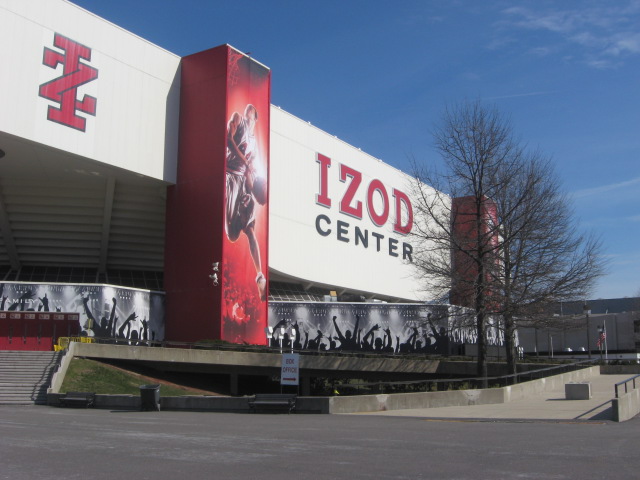
EAST RUTHERFORD, NJ - Fordham's final Izod Center appearance for this season , was a less than memorable one. Rhode Island dominated the home standing Rams 90-58 in an Atlantic Ten Conference game on Saturday.


Outside the Izod Center
on a bright (Spring?) day


The efficiencies:

 Off.
Poss.Eff.
Rhode Island75120
Fordham7775

Both teams entered the game averaging 67 possessions. With a significant deficit for most of the game Fordham was not about to milk possessions. They needed more, not less. The Four Factors:

FTA
eFG%FGAOR%TO%
Rhode Island58181420
Fordham35192820

The above table does a fairly good job telling the story. Rhode Island dominated. They started on a 10-0 run and never looked back nor were seriously threatened. Free throw rate divides made free throws by field goal attempts. Fordham had twelve free throws and 67 FGA while also canned a dozen but attempted 67 field goals. That slight 'edge' by Fordham proved a bit trivial as Rhody enjoyed huge advantages in eFG and offensive rebounding percentages.


Pre-game captains conference
run by Brian O'Connell (c).
Flanking Brian are Gary Prager(L) and John Gwynn (R)

Synergy
Rhode Island coach Jim Baron made a point of how well his team shared the ball. Decided to run Synergy on both URI and Fordham. Synergy is a metric derived in this manner:

Synergy = FG PCT/(A/FGM)

The higher the number the better. Synergy is another metric to show how teams distribute the ball. The totals for this game:

Rhode Island0.914
Fordham0.848

Rhode Island's Synergy, as the numbers show, was near excellent.

The Manley Numbers...
...provide a good illustration of Rhode Island's complete effort. Taking a look at URI's and Fordham's two leading scorers...


Player, TeamPts.Eff.
Delroy James, URI2935
N. Malesevic, URI1320
Brenton Butler, For123
Chris Gaston, For107


URI-Fordham action at Izod


Rhody's outstanding forward Delroy James played 28 minutes and his efficiency per minute was a superlative 1.25. Breaking 100 on the per minute efficiency is excellent and of the not too frequent variety. Butler's 5 of 11 from the floor and one assist, 5 turnovers significantly affected the efficiency of Fordham's senior guard.

Chris Gaston did not start but played 27 minutes. Gaston was late for the team bus and Fordham coach Tom Pecora had the sophomore star sit out the opening minutes. A perimeter oriented team, Fordham never got the inside game going. By the time Gaston entered the contest, with about 6 minutes gone, Fordham was already looking at a double digit deficit. The result saw 26% of their field goal attempts from beyond the arc. Their two point shooting , 17 of 48 (35%) was subpar. Overall a long afternoon.

On the other end URI relentlessly attacked and frequently got good or uncontested opportunities in the paint. For Fordham it was a total breakdown on both ends of the floor.


'Dance Rhythm', the Fordham dance team
Were one of Fordham's bright spots


Notes
Rhode Island improved to 18-10 (9-5 in the A-10). Fordham fell to 6-20 and 0-14 in conference. Both teams committed 15 turnovers and had equal turnover rates. Rhode Island made Fordham play dearly for their miscues. URI enjoyed a 29-13 edge in points off turnovers.

Rhode Island finishes the A-10 regular season slate hosting George Washington Wednesday then traveling to St. Bonaventure on Saturday. Fordham wraps up at LaSalle Wednesday and home for UMass three days later.


"We will get back to work.
If we play as we are capable we can win our last two
against LaSalle and UMass."
-- Fordham coach Tom Pecora.

Sunday, February 13, 2011

Guest Contributor Ray Floriani: Saint Joseph's at Fordham

by Ray Floriani
EAST RUTHERFORD, NJ - It looked like this might be the day. For a half at least. Fordham jumped out to a 12 point lead at the break before St. Joseph's came back for a 76-70 victory at the Izod Center.


Afternoon at the Izod


The Four Factors:

FTA
eFG%FGAOR%TO%
St. Joseph's57353112
Fordham49543516


The Tale of Two Halves:
The first half...
Off.
Poss.Pts.Eff.
St. Joseph's333194
Fordham3243134


The second half...
Off.
Poss.Pts.Eff.
St. Joseph's2745167
Fordham322784


The game...
Off.
Poss.Pts.Eff.
St. Joseph's6076127
Fordham7064109

Have to be impressed the way St. Joseph's came back. With a young team, on the road in the midst of a tough long season, the Hawks showed their will and stayed with it. The possessions show they did not get in a 'helter skelter' affair to rush in trying to cut the deficit. Rather, they took the approach that the final twenty minutes would provide ample opportunities to get the score to a manageable level and then put them in position to make their run.

Three point shooting was a key. The Hawks shot better beyond the arc than inside. The three point shooting came at a 64% rate (7 of 11) the second half. Two point shooting was 5 of 9 (56%). Overall St. Joseph's shot 60% (12 of 20) after going 11 of 31 (36%) the first half.

Both teams cared for the ball very well. Fordham had a slight rebounding edge offensively. Kervin Bristol and Chris Gaston had 10 rebounds each for the Rams.

Beside the increased offensive efficiency on the part of the Hawks, Fordham also struggled the final half as the production of two key players feel a bit. Alberto Estwick had a dozen at the half and Gaston had 8 points 7 boards in the books. The second half saw Estwick garner two points while Gaston had a relatively quiet 6 points 3 boards.

The damage inflicted on Fordham came courtesy of two young guards. Freshman Langston Galloway hit for 25 points while sophomore Carl Jones scored 15. Charoy Bentley, followed a solid performance against UMass, with a solid 14 points (5 of 7 shooting) in 23 minutes of relief. Langston and Jones however, took 43% of their team's shots while producing 53% of the points. They each scored a dozen in that game changing second half.


Fordham huddles before coming out the second half


Crunch Time
The shot chart the last eight minutes (St. Joseph's led 57-55 with eight to go) showed the Hawks scored six field goals. Four were off set offense. Two in transition and the last one on the break came by breaking full court pressure with under two minutes to go. The Rams had four field goals. Two were treys (by Branden Frazier) while the last two were on penetration baskets very late with the Hawks enjoying a two-three possession lead.

Numbers and Notes
Fordham is now 6-17 (0-11 in the A-10). St. Joseph's is 7-17 (2-8). Galloway's 25 points paced all scorers. Frazier and Brenton Butler paced the Rams with 17 points each.

One thing missing from the media room the prior two Fordham games at Izod was coffee. Today it was here, in full glory. Regular or decaf.

Win over Fordham was the Hawks' second straight. They entertain Xavier on Wednesday. Fordham's next game is also with Xavier, on the road February 19th. Win was number 1,500 in St. Joseph's long and tradition rich history.


"At the half I was worried about them (St. Joseph's )
playing harder than us the second half.
And they did." - Fordham coach Tom Pecora

Monday, January 31, 2011

Guest Contributor Ray Floriani: St. Bonaventure at Fordham

by Ray Floriani
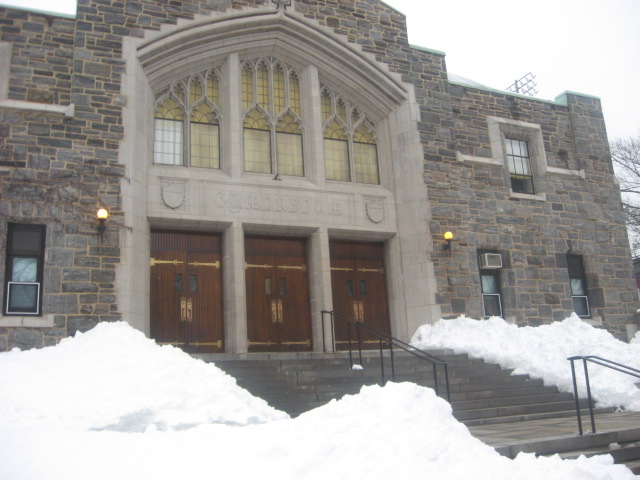
BRONX, NY- St. Bonaventure bounced back from a tough home loss to UMASS on Wednesday, defeating Fordham 69-60 at Rose Hill on Saturday.


Outside Rose Hill Gym
Enough with the snow but at least its photogenic


The pace and efficiency:

 Off.
Poss.Eff.
St. Bona67103
Fordham6790


The Four Factors:

FTA
eFG%FGAOR%TO%
St. Bona46552412
Fordham3873512


Inside Rose Hill Gym


Free Throw Rate.
The Bonnies were 26 of 41 from the line while Fordham was 5 of 9. Rams coach Tom Pecora had nothing but praise for the officials. On the disparity from the stripe he said, "they (Bonaventure) came out aggressive. When you come out like that you put yourself in a position to get calls and get to the line. Give them credit. We came out too passive."

Mark Schmidt of Bonaventure added, "we get to the line a lot in our games. Our philosophy is inside/out. We get the ball inside and as a result get opportunities to go to the free throw line."

Fordham led 17-8 in offensive rebounds. A strong second half showing on the glass was responsible for the edge in the OREB percentage category.

TO rate was a revelation for the Bonnies especially. They had been plagued with turnover problems in recent seasons. On the season both clubs have a 21% TO rate. And in this contest they showed outstanding TO rate numbers.


Forward/Center Andrew Nicholson shows his form


Crucial Four
The first four minutes of both halves are critical to setting a tone. Fordham, down 36-20 at intermission, utilized those opening minutes to their distinct advantage. On Bonaventure's opening possession Andrew Nicholson was fouled in the act of shooting. Nicholson missed both free throws. Fordham scored on their first three possessions of the half. The Bonnies missed shots on the two possessions following Nicholson's misses from the line. Instead of a potential 18 point Bonaventure margin, the Ram deficit was 10 points with about 17 minutes to play in front of an energized home crowd. Fordham closed the four minute stretch with a 9-2 scoring edge in 6 possessions. The efficiencies for that juncture were Fordham 150 and Bonaventure 33. More important, a lead that took the Bonnies about a half to build was virtually sliced in half in the span of just four minutes.

Defending the Three
Taking a cue from David Hess' Project Scoresheet on the Audacity of Hoops site, I decided to chart every field goal attempt from three point range. For uncontested attempts, a notation was made. The results:

1st Half3 Point Shooting
OverallUncontested
St. Bona3-4 (75%)2-2 (100%)
Fordham3-11 (27%)0-2 (0%)


2nd Half3 Point Shooting
OverallUncontested
St. Bona2-7 (29%)2-5 (40%)
Fordham2-11 (18%)2-6 (33%)

For the game, the numbers were:

Game3 Point Shooting
OverallUncontested
St. Bona5-11 (46%)4-7 (57%)
Fordham5-22 (23%)2-8 (25%)

Seven of the 11 three point attempts by the Bonnies were uncontested. That was largely due to the inside game and the attention afforded Nicholson by the Fordham defense. The Rams just did not close out quicker on perimeter shooters. Also, the likes of freshman Matthew Wright (9 points on 3 of 5 beyond the arc) shot some very deep threes.

On the Fordham side, the Bonnies did a good job ensuring the Rams got a minimum of open, uncontested looks. They did get 6 uncontested looks the second half. Chalk that up to a few Fordham attempts in transition and with Chris Gaston more effective in the paint the final twenty minutes, the perimeter opened up a bit.

Numbers
St. Bonaventure is 11-9 (3-4 A-10). The Rams drop to 6-13 (0-7). Andrew Nicholson led all scorers with 25 points. The Bonaventure junior added 11 boards. Brenton Butler paced Fordham with 15 points while Chris Gaston led the Rams with 11 rebounds. Game was a sellout at Rose Hill. Gaston finished with 11 points and was well defended especially the second half. Fordham did own a 30-24 points in the paint edge. That was largely due to the second half and not just on posting up. The Rams were successful those final 20 minutes in hitting the offensive boards and getting dribble penetration. Demetrius Conger, a sophomore forward, finished with 11 points 5 rebounds and made a few big plays to allow the Bonnies to maintain the lead when Fordham made its second half run. Attendance was a sold out 3,200.


Bonaventure coach Mark Schmidt meets the media

Thursday, January 20, 2011

Guest Contributor Ray Floriani: St. Louis at Fordham

by Ray Floriani
EAST RUTHERFORD, NJ - St. Louis was dominant the last ten minutes of the game. The Billikens pulled away in the stretch defeating Fordham 68-55 at the Izod Center on Wednesday.


Pre-game officials and captains conference.
Officials are (l-R) Mike Roberts, Joe DeMayo and John Gwynn


The efficiency numbers:

 Off.
Poss.Eff.
St. Louis7196
Fordham7276

St. Louis opts for a low sixties tempo. Fordham coach Tom Pecora decided to speed them up. Mission accomplished. Fordham used 'blitzes', traps and some full court pressure to speed the game up. "Sometimes you get turnovers," Pecora said. "Even if they do not turn it over they may rush and take a quick shot. At any rate the faster pace gives us more possessions."

The Four Factors:

FTA
eFG%FGAOR%TO%
St. Louis56272327
Fordham31552325


Game action


The Rundowns:
St. Louis
Coach Rick Majerus immediately addressed the turnovers. Interestingly, a good deal of the TOs (19) did not come from Fordham pressure. "We had about seven turnovers that were offensive fouls," Majerus said, "such as illegal screens."…The eFG mark was very impressive given 41% of their field goal attempts were from beyond the arc. Their three point percentage was an impressive 45% (9 of 20). Good, fast ball movement and the Rams' inability to close out on several possessions, gave the Billikens a number of good looks. Cody Ellis (3 of 4) on the game proved to be the deadliest shooter from beyond the arc. St. Louis 'lost' the free throw rate category. Chalk it up to some overly aggressive defense which is not always a negative. St. Louis was whistled for 30 personals to Fordham's 22. A number of the Fordham free throws were attempted in the stretch with the outcome virtually decided.


The St. Louis huddle
before start of the second half


Fordham
If it was a high school game of 32 minutes the Rams would probably have an A-10 win or two. The Rams actually took a 40-39 lead just before the ten minute mark. Alas, the game is 40 minutes. As Tom Pecora said it is a recurring theme. "We are right there for 30 minutes," he said, 'then fatigue sets in we get breakdowns. Teams get separation on us now down the stretch we are playing catch up..." Guard play is another concern. Chris Gaston did his part with 24 points, almost completely responsible for a 22-20 Fordham edge on points in the paint. Four primary guards Brandon Frazier, Lamount Samuel, Alberto Estwick and Brenton Butler combined for 27 points on 5 of 24 shooting. Pecoca made it a point to mention guard play must improve. "A lot of our younger guards did not realize the physicality of the Atlantic Ten," the Fordham mentor said…Free throw rate was a positive. Taking the made free throws divided by field goal attempts showed Fordham utilized opportunities from the charity strip as they were 26 of 32 from the floor…Rams had seven field goals the second half. The shot chart revealed every one by Gaston and six in the paint, the other on the right block just outside the lane.

Numbers
St. Louis is 7-11 (2-3 in the Atlantic Ten). Fordham is 6-10 (0-4) and has lost four straight. Chris Gaston was the game pacesetter in scoring with 24 points and rebounding (10). Kyle Cassity led St. Louis with 13 points. Freshman forward Dwayne Evans had a nice 12 point 8 board effort for St. Louis. The Billikens blocked two shots. A surprising one was by 6-1 guard Jordan Jett who rejected at attempt by Gaston in the paint. Rams next Izod date is February 13th against St. Joe's.


Exiting the Izod Center

Thursday, January 6, 2011

Guest Contributor Ray Floriani: Temple at Fordham

by Ray Floriani

EAST RUTHERFORD, NJ - They showed the reason, or reasons, they are the front runner in the Atlantic Ten. Temple defeated Fordham 70-51 at the Izod Center in the A-10 opener for both teams


Outside the Izod
on a chilly night

The early seven point lead enjoyed by the Rams due to a fast start and some hot three point shooting, soon dissipated. Fordham cooled off from the field and Temple made a concerted effort on go inside. At the half the Owls enjoyed a significant 22-8 edge in points in the paint. Chris Gaston, the Rams main and arguably only inside threat, had a very ordinary 4 point half on 2 of 5 shooting. Halftime saw a 35-27 Temple advantage. The Owls used 37 possessions, Fordham 36. Temple enjoyed a clear cut 95-75 offensive efficiency edge at intermission.

The first four minutes of the second half saw Temple go on a 11-2 run, extending the lead to 46-29. The Owls attacked inside and out while Fordham's only basket was on a transition dunk by Chris Gaston.

The remainder of the second half was all Temple. The Owls were dominant and never seriously challenged the rest of the way.

The efficiency numbers:

 Off.
Poss.Eff.
Temple7199
Fordham6875

The Four Factors:

FTA
eFG%FGAOR%TO%
Temple49164625
Fordham4622125

Temple's dominance on the inside game is reflected in the numbers. The Owls pounded the offensive glass, held a 38-18 points in the paint edge and as Fordham's free throw rate shows, did not allow the Rams to set up a post up game that could get them to the line.

Temple shot 52% (24 of 46) from two point range while Fordham was 35% (13 of 37).


Game action Temple vs. Fordham


Both teams were 25% on the TO rate. A fact not overlooked by Temple, a team that entered the contest with a sterling 18% TO rate.

Final Numbers.
Temple had four players in double figures. Reflecting their inside/outside offensive philosophy there were two interior and perimeter players among the four. Lavoy allen (12 points) and Micheal Eric (14 points 11 boards) did the job in the paint while Juan Fernandez and Ramone Moore had 15 apiece at the guard spot.

Branden Frazier, a freshman guard, paced Fordham with 16 points. Chris Gaston was defended very well and the Ram sophomore settled for 8 points, 5 rebounds on the night. Gaston shot 4 of 7 from the floor and struggled to get a decent look all night.

The 'Manley formula' efficiency leaders:

Efficiency
Michael Eric, Temple22
Branden Frazier, Fordham18
Juan Fernandez, Temple17
Ramone Moore, Temple16

Temple is 10-3 (1-0 A-10) while the Rams are 6-7 (0-1).


Temple coach Fran Dunphy
has the Owls the class of the A-10

Tuesday, November 16, 2010

A Progress Report on the A-10's Out of Conference Schedule

The Conference Breakdown
Given the conference's footprint stretches from central Carolina north to New England and west to the Mississippi, it comes as no surprise that 29 of Division 1's 31 (not counting the Atlantic-10 itself) are represented in the out of conference (OOC) schedules of the 14 members...

Games
ConferenceSchedPlayed
Atlantic Coast Conference11
American East10
Atlantic Sun4
Big Ten4
Big 1231
Big East182
Big South41
Colonial Athletic Association161
Conference USA5
Great West2
Horizon League6
Independents1
Ivy League92
Mid-Atlantic Athletic92
Mid-American142
MidEastern Athletic 81
Missouri Valley2
Mountain West1
Northeast Conference92
Ohio Valley21
Pacific 104
Patriot League7
Sun Belt32
Southeast Conference6
Summit League3
Southern Conference71
SouthWest Athletic Conference2
Western Athletic Conference1
West Coast Conference2

[Note -- the list does not reflect 2nd, 3rd and 4th round opponents in early season invitational tournaments. Expect more above the Red Line conference games as those parts of the schedule become official...]
The mix certainly reflects the different regions from which the conference draws it's membership. As expected, the ACC, American East, Big East, CAA, Ivy and MidAtlantic Athletic Conference (MAAC) are well represented in the composite schedule. The Mid American Conference (MAC) seems over represented, though both Dayton and Xavier hail from the upper Midwest and traditionally schedule several MAC teams. Temple however, has a football affiliation with the MAC, and is contractually obligated to schedule a handful of MAC teams (the Owls would no doubt have one or two on the schedule anyway), this season the number is five (of the Owls' 13 OOC games).

The composite record so far (midday 11/16) is 11-7 (0.611), with losing records against the Big 12 (La Salle lost to Baylor), the Big South(!) and the Ohio Valley(!) Conferences.

Pleasant Surprises
While beating The Citadel & William & Mary was expected, the margin of victory caught my interest. According to Ken Pomeroy the efficiency with which the Spiders dispatched those opponents was mid-season form...

Efficiency
Off.Def.Diff.
The Citadel1.230.58+0.66
William & Mary1.140.77+0.38

Granted neither opponent is a Top 100 RPI team (they will both probably end up in the 200 range when the season goes into the books), but the efficiency differentials are impressive, and the point margins of +42 and +27 respectively suggest Coach Mooney has this team ready to play. If the Spiders handle a few of their more challenging OOC opponents (Arizona State, Georgia Tech, Seton Hall -- on the road) with the same ease, they should find themselves on a few AP and Coaches Poll ballots going into the A-10 regular season.

Consistent with last season, Temple continues to show well against above the Red Line opponents. The Owls opened with a six point win over the Pirates of Seton Hall (Big East). If the Hall recovers their step, this win should look very good on Temple's resume going into Selection Sunday.

Pittsburg is expected to dominate the Big East this season, but the Panthers had all they could handle from Coach Baron's Rhode Island squad. All the more remarkable because the squad that stayed within a possession of Pitt to the last 1:20 of the game was still unsettled as late as the start of classes in early September. Should the coach be able to build on this early season surprise (a trademark of Rhodi teams in the Baron Era), the Runnin' Rams might be able to use an expected early conference regular season return of Orion Outerbridge as the energy boost to power them through that late season wall they hit last season.

Disappointments
True Gardiner-Webb housed Kentuky two seasons ago, but this Big South team is not returning an experienced squad nor expected to compete for a Big South title this season. The 90-81 win over South Carolina State last weekend evened Coach Major's record and will get the 49ers ready for their game against George Mason later this week.

Tom Pecora's debut at Fordham was also disappointing, though the 61-58 loss to Brown (Ivy League) was closer than Coach Major's debut. Like Charlotte, Fordham turned it around in the second game, dispatching Sacred Heart (NEC) by a double digit margin.

Coach Majerus is no doubt re-tooling the Saint Louis offense and defense with the loss of senior Willie Reed and junior Kwamain Mitchell, two of the squad's recognized leaders, on the eve (literally) of fall practice. Neither will be available before late December (if then). The shuffle explains the Billekins' 64-62 opening loss to Austin Peay (Ohio Valley Conference). The Governors are a middling OVC team whose RPI typically ranks somewhere in the mid 100s by season's end. Not the kind of home loss that will help St. Louis' tournament resume (nor the conference's overall standing). The Billikens were expected to challenge for conference elite status this season, but may spend much of the OOC (quickly) integrating newcomers in place of the missing parts and, much like last season, surge at the end of the conference schedule, playing more the spoiler (again) than the next conference "It" team. Too bad given the A-10's potential to take three or four NCAA bids.